Articles
-
 Article
Long-lasting gut microbiome and fecal metabolome alterations after colorectal adenoma removal and their relationship to colorectal cancer
Highlights Тhe gut microbiome a decade after adenoma resection partially resembles that in CRC Аdenoma-CRC shared microbes strongly correlate with lifestyle factors Sphingolipid enrichment characterizes the adenoma fecal metabolome Adenoma-specific microbe-metabolite links emerge independent of abundance shifts
-
 Article
Probiotic formula intervention in infants leads to colonization and competitive strain displacement independent of IgA binding
Early-life microbiota assembly is affected by environmental exposure, diet, and immunity. We performed shotgun metagenomics sequencing of fecal samples (N=401) from a controlled infant intervention trial to evaluate how pre- and probiotic exposure affects bacterial strain dynamics, maternal-to-offspring strain transmissibility, strain persistence, and host immune responses. Species- and strain-level analyses revealed that the early-life intervention with Bifidobacterium longum subsp. infantis (BL subsp. infantis), Bifidobacterium breve, and galacto-oligosaccharides (GOS) replaced main resident strains of these species unlike breast-feeding and exclusive infant formula.
-
 Article
Multi-cohort proteogenomic analyses reveal genetic effects across the proteome and diseasome
Highlights Proteogenomic evidence from the largest multi-cohort (n = 38) study to datе Identification of genes, pathways, and cell types that modulate circulating protein levels Circulating protein signatures with genetic evidence that inform drug repurposing Proteogenomic insights into mechanisms underlying diverse diseases
-
 Article
Genome-wide sweeps create ecological units in the human gut microbiome
Here we show that genome-wide selective sweeps are a pervasive mechanism that differentiates bacteria in the microbiome. This mechanism leads to population structures akin to global epidemics across geographically and ethnically diverse human populations. Such sweeps arise when an adaptation allows a clone to outcompete others in its niche followed by rediversification, and they manifest as clusters of closely related genomes on long branches in phylogenetic trees.
-
 Article
Clinical and Mechanistic Evidence for Comano Thermal Water: A Narrative Review
Comano thermal water (CTW) is a hypotonic, bicarbonate–calcium–magnesium mineral water traditionally used to manage chronic inflammatory and relapsing skin diseases. This review summarises and discusses the available clinical, experimental, and translational evidence on CTW, with a particular focus on dermatological indications.
-
 Article
The Infant Gut Virome: Knowns, Unknowns, and Avenues for Future Studies
This work has highlighted dynamic changes during infancy and associations between viruses and infant diseases. While research on the gut virome is still in its early stages, the ability of viruses to influence the ecosystem means the gut virome holds significant potential for improving future microbiome-based treatments.
-
 Article
Early pregnancy is characterized by a significant decrease in the diversity of the oral microbiome and strong associations with lifestyle and conception method
This study provides the first large-scale evidence of significant oral microbiome changes beginning in early-mid pregnancy, characterized by reduced diversity and a directional shift toward inflammation-associated communities. Strong associations between gluten consumption and smoking suggest a lifestyle effect on the oral microbiome.
-
 Article
Associations of continuous glucose monitor derived time in range and glycaemic variability with diet lifestyle and demographics
Continuous glucose monitors (CGMs) provide detailed glucose profiles, but their relevance to health outcomes in individuals without diabetes remains unclear. Here we assess time in range (TIR3.9–5.6 and TITR3.9-7.8) and glycaemic variability in individuals (N = 3,634; age 46 ± 12 y; 83% female; BMI 27 ± 6 kg/m²) from PREDICT 1 (NCT03479866), PREDICT 2 (NCT03983733), and PREDICT 3 (NCT04735835) without diabetes or prediabetes, and explore associations with demographic, diet, lifestyle, cardiometabolic markers, and predicted cardiovascular risk.
-
 Article
Extensive genomic diversity in Desulfovibrio species reveals species-specific functional traits associated with disease
Desulfovibrio spp. are associated with inflammatory diseases and human health, yet limited representative genomes and isolates hinder our understanding of their role in disease. Here, we assembled a comprehensive database of 2,658 Desulfovibrio genomes across 90 diseases and 32 countries, including 24 human isolates. Genomic analyses showed extensive species diversity and revealed disease-associated functional traits, including flagellin and virulence genes (i.e. ureases).
-
 Article
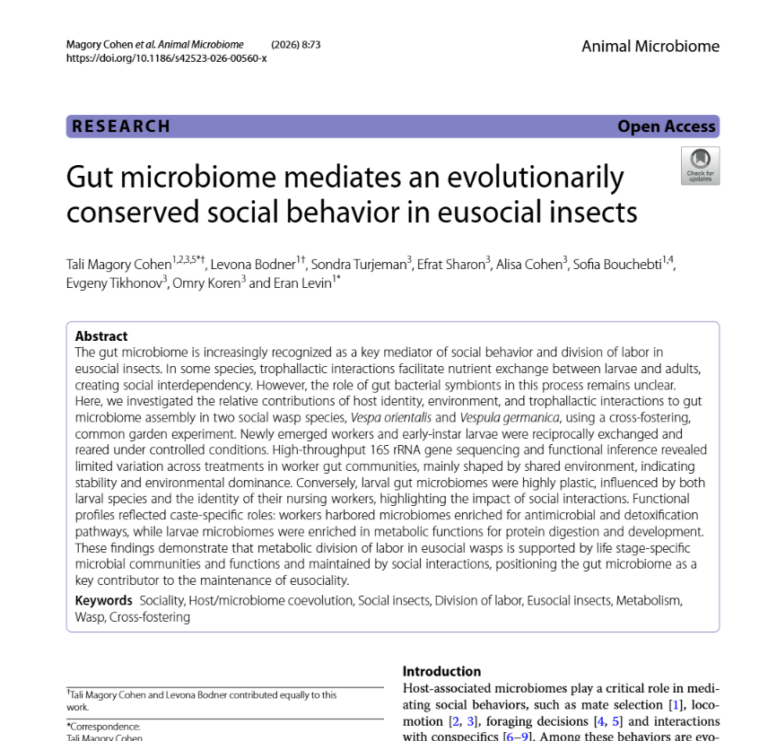
Gut microbiome mediates an evolutionarilyconserved social behavior in eusocial insects
The gut microbiome is increasingly recognized as a key mediator of social behavior and division of labor in eusocial insects. In some species, trophallactic interactions facilitate nutrient exchange between larvae and adults, creating social interdependency. However, the role of gut bacterial symbionts in this process remains unclear. Here, we investigated the relative contributions of host identity, environment, and trophallactic interactions to gut microbiome assembly in two social wasp species, Vespa orientalis and Vespula germanica, using a cross-fostering, common garden experiment.